
What Does IDM Mean in Text?
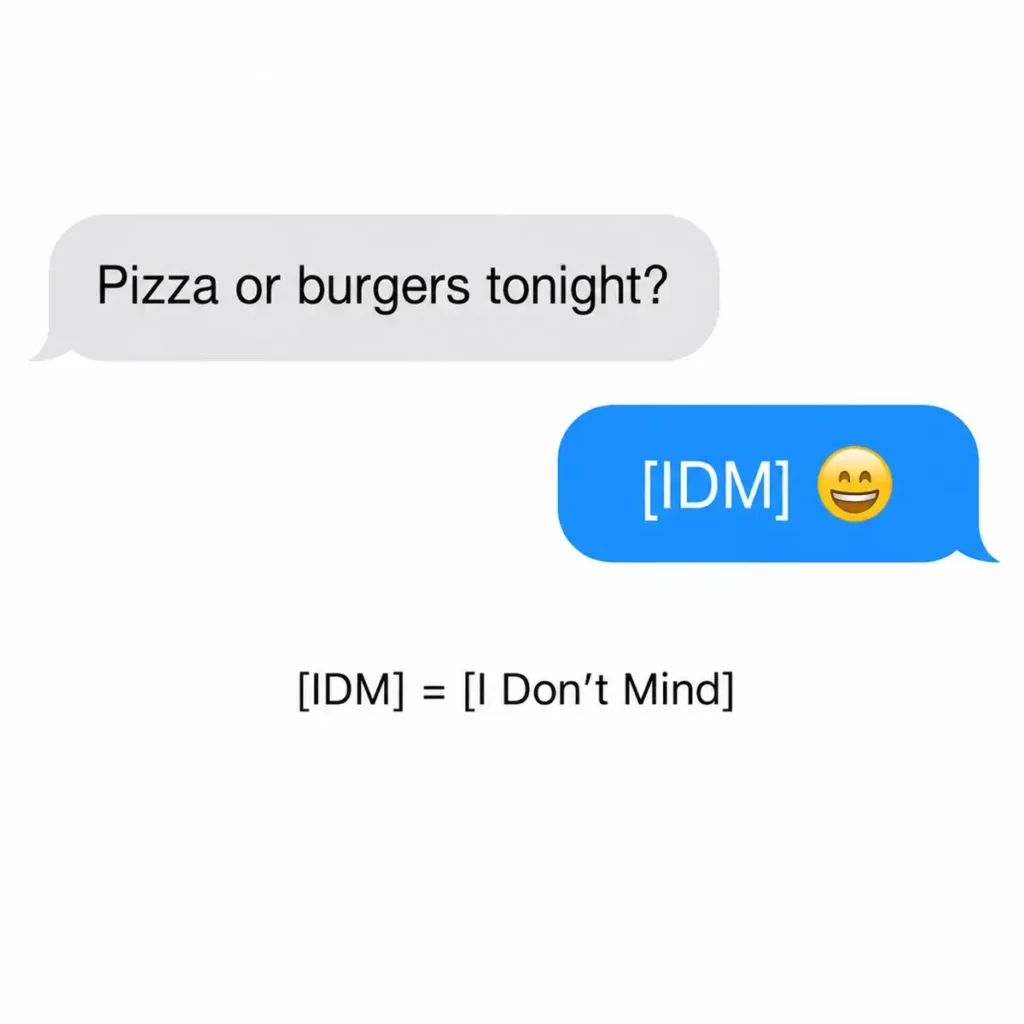
Want to know IDM Meaning in Text? IDM stands for “I don’t mind” in texting. It’s a quick way to say you’re fine with either option, no preference either way.
A: Do you want pizza or tacos tonight? B: IDM, you pick.
Every Meaning of IDM
The primary meaning is “I don’t mind” — a casual, low-effort signal that you’re flexible and leaving the decision to someone else. It’s not agreement exactly, more like an open hand.
| Meaning | Field | When You’d See It |
|---|---|---|
| I don’t mind | Everyday texting | Friend asking for a preference |
| Intelligent Dance Music | Music / Reddit | Discussions about electronic genres like Aphex Twin |
| It doesn’t matter | Informal texting | Less common, mostly UK usage |
| I do mind | Sarcasm | Rare, context-dependent |
Context does the heavy lifting here. If someone texts you IDM after you ask what movie to watch, they mean “I don’t mind.” If you’re on a music subreddit and someone mentions IDM, they’re talking about Aphex Twin, not their feelings. The surrounding conversation tells you everything within seconds.
A note on the sarcastic read: some people use IDM sarcastically to mean “I do mind, actually” — this only works with the right tone cues, usually paired with a period or a follow-up message. It’s rare but it happens.
Where IDM Came From
IDM Meaning in text grew out of the same era that gave us BRB, LOL, and AFK — the early 2000s SMS and instant messaging boom when character limits and slow keyboards made abbreviations genuinely useful. Typing “I don’t mind” on a Nokia numpad took long enough that shaving it to three letters actually saved time.
The phrase itself is distinctly British in origin. “I don’t mind” is more common in British and Australian English than American English, where “I don’t care” or “whatever” tends to fill the same slot. That geographic lean is part of why IDM never hit the mainstream as hard as some of its contemporaries. It spread gradually through MSN Messenger, then picked up again on WhatsApp and iMessage in the 2010s. On platforms like Snapchat and Instagram DMs, it now shows up regularly across all English-speaking regions, though it still skews toward UK and Australian users in frequency.
Real Conversation Examples
Planning with a friend:
A: Should we meet at 6 or 7? B: IDM, whatever works for you.
Cold, short use:
A: Want to grab food after? B: IDM.
Warm with emoji:
A: Is it okay if we do a movie instead of dinner? B: IDM at all 😊 sounds good to me
Gaming context:
A: You want to pick the map or should I? B: IDM bro just not Dust II again lol
Dating context:
A: Any restaurant preference? I was thinking Italian. B: IDM as long as there’s good pasta 😂
Semi-professional context (group chat):
A: Does Thursday or Friday work better for the check-in? B: IDM either way, just send a calendar invite.
Checking in after a decision:
A: I went ahead and booked the 7pm slot. B: IDM at all, that’s perfect.
Slightly exasperated use:
A: Do you want the window seat or aisle? B: IDM, I genuinely don’t care 😭
Tone shifts fast with this one. “IDM” with no punctuation reads breezy and unbothered. IDM Meaning in Text with a period reads curt, almost dismissive. “IDM…” trails off into something that sounds less certain, maybe even passive-aggressive depending on what came before it. Add an emoji and it warms right back up. The word count is the same across all of these — the delivery is doing all the emotional work.
IDM on Different Platforms
| Platform | Tone | Typical Use | Example |
|---|---|---|---|
| Casual to semi-formal | Group decisions, making plans | “IDM which café, you choose” | |
| Snapchat | Very casual | Quick replies, low-stakes choices | “idm lol” |
| iMessage | Casual to warm | Friends and family, daily logistics | “IDM at all 😊” |
| Twitter / X | Rare | Usually music-related (IDM genre) | “Anyone else into IDM lately?” |
| Music context | Electronic music discussions | “This sounds like classic IDM” |
WhatsApp is where IDM does most of its work in daily life. Group chats use it constantly for decisions about where to eat, what time to meet, or who’s driving. It reads as polite and easy-going here, not evasive — the group dynamic actually benefits from someone stepping back and letting others decide.
IDM Meaning in Text in Snapchat tends to strip it down further. Capitalization goes out the window, and it’s usually paired with “lol” or nothing at all. The platform’s casual DNA means nobody reads much into it — it’s just a fast answer.
IDM Meaning in Text in iMessage sits in between. People use it with friends and family, so IDM can be warm or completely neutral depending on the conversation. This is also where the emoji pairing happens most naturally, since the platform makes them easy to add mid-sentence.
IDM vs. Related Abbreviations
| Abbreviation | Full Phrase | Emotional Tone | When to Use It |
|---|---|---|---|
| IDM | I don’t mind | Neutral, flexible, agreeable | Leaving a choice to someone else |
| IDC | I don’t care | Detached, sometimes cold | When you truly have no stake in the outcome |
| IDA | I don’t actually | Casual correction | Walking back a previous statement |
| IDGAF | I don’t give a [expletive] | Strong, often frustrated | Emphasis, attitude, or humor |
| WYP / WYC | Whatever you prefer / choose | Gentle, deferential | Explicitly handing the decision over |
IDM and IDC get confused constantly, and it matters. IDM Meaning in Text sounds cooperative — you’re saying you’re fine with whatever. IDC sounds indifferent at best, dismissive at worst. If someone asks what you want for dinner and you reply “IDC,” it can read like you couldn’t be bothered to engage. IDM in the same spot sounds like you’re genuinely leaving it in their hands. One is detachment, the other is flexibility. They’re not the same thing, and using IDC when you mean IDM is a surprisingly easy way to come off ruder than you intended.
How to Reply When Someone Texts You IDM
When someone sends IDM, the decision is yours now. They’ve explicitly stepped back — so the most useful thing you can do is just make the call.
“Okay, let’s do [option].” — when you actually have a preference; just lead with it.
“Are you sure? I want to pick something you’ll actually enjoy.” — when IDM feels like it might be polite deflection and you want to check.
“Random pick: [option]. We’re going with this.” — works great for low-stakes group decisions where someone needs to break the tie.
“Same honestly, flip a coin?” — when you also have no preference and want to share the indecision rather than escalate it.
“Okay but if you had to choose?” — a light push that invites them to give a real answer without pressure.
“I’ll just book [option] then — let me know if that doesn’t work.” — the decisive move for planning contexts; gives them an out without making it a whole thing.
“Perfect, [time/place] it is.” — clean confirmation that moves the conversation forward.
What not to do: don’t just reply “same” or send another IDM back. It stalls the conversation and neither of you ends up making a decision.
When IDM Sounds Fine — and When It Doesn’t
By default, IDM reads as cooperative. Someone asks a question, you don’t have a strong preference, you say IDM — transaction complete, everybody happy. That’s the neutral read, and it’s genuinely the most common one.
The cold read happens when IDM comes in with no context and no warmth. “Are you upset about last night?” / “IDM.” That’s not flexibility anymore. It’s distance. The person receiving it is very likely to read something into it, whether or not that was the intent.
The passive-aggressive read is rarer but real. “IDM.” with a period, especially after a disagreement, can carry a lot more weight than three letters should. Compare that to “IDM 😊” — same sentiment, completely different emotional temperature. Punctuation changes the read more than most people realize. “IDM” is easy-going, “IDM.” is guarded, “IDM…” is loaded.
A: I already made the reservation without asking, hope that’s fine. B: IDM.
That period is doing a lot of work.
What IDM Doesn’t Mean
IDM doesn’t mean “yes.” A lot of people treat it as an agreement, but it’s not. It means you have no objection, not that you’re enthusiastic. Texting IDM to a plan you actually hate is going to cause problems.
IDM doesn’t mean the same thing as IDC. “I don’t mind” implies goodwill. “I don’t care” implies detachment. The difference matters, especially in emotional conversations where word choice signals how invested you are.
IDM doesn’t always mean “I don’t mind” in every context. On music forums, Discord servers about electronic music, or certain Reddit communities, IDM almost always refers to the genre — Aphex Twin, Boards of Canada, Squarepusher. Reading it as “I don’t mind” in those spaces is going to be confusing.
IDM isn’t sarcasm by default. Some people assume the “I do mind” reading because they’ve seen it used that way. That’s a niche, sarcastic use — nowhere close to the standard interpretation. Assume “I don’t mind” unless there’s an obvious signal otherwise.
IDM isn’t a British-only term anymore. It skews that direction historically, but it’s used across English-speaking countries today. American users send it too, especially younger people who picked it up through social media rather than regional speech patterns.
FAQ
Q: What does IDM mean in text? A: IDM stands for “I don’t mind.” It’s used when someone has no preference and is leaving a choice up to the other person.
Q: Is IDM the same as IDC? A: No. IDM means “I don’t mind” and sounds cooperative. IDC means “I don’t care” and can sound indifferent or even dismissive depending on the context.
Q: Can IDM mean something else? A: Yes — in music communities, IDM stands for “Intelligent Dance Music,” an electronic genre. In rare cases, it’s used sarcastically to mean “I do mind.”
Q: Is IDM rude? A: Not inherently. But how you punctuate it changes the feel — “IDM” reads casual, “IDM.” with a period can read terse or cold, especially after a tense conversation.
Q: How do I respond to IDM in text? A: Just make the decision. IDM is an invitation for you to take the wheel, so the most useful response is picking an option rather than bouncing the choice back.
Q: Is IDM more common in British English? A: The phrase “I don’t mind” is more distinctly British, so the abbreviation has roots there. It’s used widely now across English-speaking regions, especially among younger users.
Q: Can I use IDM in a professional message? A: Only in informal contexts like a team group chat. In a formal email or with someone you don’t know well, write it out — “I don’t have a preference” reads more clearly and professionally.
Conclusion
IDM is one of those abbreviations that’s easy to overread or underread. Most of the time it means exactly what it says: no preference, your call. The tone, the punctuation, and the surrounding conversation are the real clues to whether it’s breezy or loaded. When in doubt, take someone at their word — and just make the decision they handed you.

Dating Enthusiast & Love Language ProJade hails from Chicago and brings a bold, confident voice to romantic expression. Her writing focuses on empowering women to be playful, direct, and irresistible through text. She loves helping readers master the art of the “first move.”